News

12 Oct 2016

Colloque Wright 2016

This year, we will hear from specialists, including a Nobel Prize, in areas that are profoundly transformed by the advent of genomics.
10 Oct 2016

How phalanx-joint formation is coordinated in mammals?

Jozsef Zakany collaborated to a study led by researchers from the NIH, who uncovered the existence of an interdigit signaling center that instructs coordinate phalanx-joint formation in mice embryos.
05 Oct 2016

Nobel Prize 2016 in Medicine explained by Brigitte Galliot

The Nobel Prize in Physiology or Medicine 2016 was awarded to Yoshinori Ohsumi "for his discoveries of mechanisms for autophagy”. Brigitte Galliot explains the importance of this discovery.
19 Sep 2016

Physics of Biology II international meeting

For the past fifteen years, an interest for Quantitative & Systems Biology has been raising in the scientific community. Major advances in this direction have been driven by the integration of physics and computer science approaches with innovative technological developments in molecular biology, optics, micro- and nano-manipulations. Although Quantitative & Systems Biology is very recent, it has already significantly spread through many fields of life sciences: genetics, biochemistry, cell biology, development, ecology and many others.
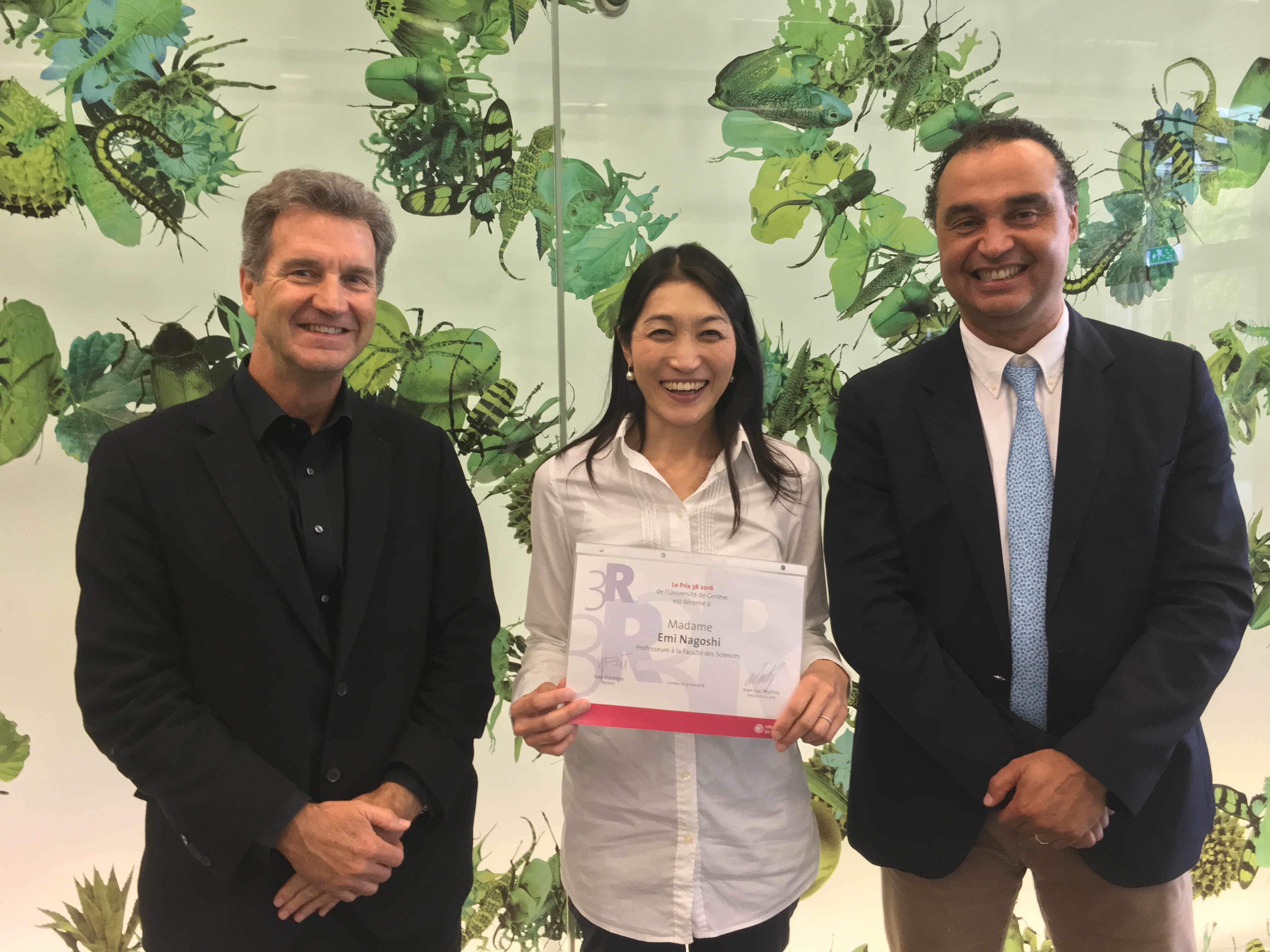
Professor Emi Nagoshi wins the 3R Award
15 Sep 2016

Professor Emi Nagoshi wins the 3R Award

The winner of this first edition of the 3R Award is Professor Emi Nagoshi, from the Department of Genetics and Evolution of the Faculty of Sciences, for her project entitled “A conserved role for p48 homologs in protecting dopaminergic neu­rons from oxidative stress”. She will receive her Award on Monday, September 19th at 9:45am.
07 Sep 2016

H2020 should focus on innovative collaborative discovery research, not on technology readiness

To forge better links not only between university research laboratories but also with companies, there should be more room for bottom-up, collaborative research in the EU’s framework research programme – specifically in Horizon 2020’s pillars II and III. Today, the League of European Research Universities (LERU) issues a Note to call attention to this issue. Feel free to read the attached PDF.
01 Sep 2016

2016 Louis-Jeantet Symposium

The fifth edition of the Louis-Jeantet Symposium will be organised by Denis Duboule, chairman of the Department of genetics and evolution at the Faculty of Science, University of Geneva, and professor at the EPFL School of life sciences, and by Konrad Basler, chairman of the Institute of Molecular Life Sciences, University of Zurich.
Hydra can modify its genetic program
15 Dec 2015

Hydra can modify its genetic program

Champion of regeneration, the freshwater polyp Hydra is capable of reforming a complete individual from any fragment of its body. It is even able to remain alive when all its neurons have disappeared. Researcher the University of Geneva have discovered how: cells of the epithelial type modify their genetic program by overexpressing a series of genes, among which some are involved in diverse nervous functions. Studying Hydra cellular plasticity may thus in uence research in the context of neurodegenerative diseases. The results are published in Philosophical Transactions, the journal of the Royal Society.
Discovery of the mutation responsible of amelanism in the corn snake
24 Nov 2015

Discovery of the mutation responsible of amelanism in the corn snake

Researchers in the laboratory of Michel Milinkovitch have identified in the corn snake the mutation responsible for amelanism, a form of albinism due to a defect in the production of melanin (the black and brown pigments of the skin). The skin of the wild type corn snake exhibits a light orange background colour covered with a pattern of dark orange dorsal saddles and lateral blotches that are outlined with black. However, some individuals do not correspond to that standard morphology: they lack all signs of melanin in the skin and eyes. The Swiss team decided to search for the DNA mutation that determines that specific coloration. To this end, they bred wild-type corn snakes with amelanistic individuals and they sequenced each offspring born from that cross. “Thanks to that large amount of sequencing data, we identified the malfunctioning gene”, explains Milinkovitch. That gene is called OCA2 and codes for a receptor located in the membranes of intracellular compartments, called melanosomes, that contain melanin. This receptor controls the proper level of acidity allowing for the synthesis of melanin.
Reptilian Genomics and Transcriptomics make a leap forward
14 Nov 2015

Reptilian Genomics and Transcriptomics make a leap forward

Reptiles are poorly represented in genomic and transcriptomic databases, hindering functional evolutionary and developmental studies in these lineages substantially more diverse than mammals. In addition, different authors have used different assembly and annotation protocols, inhibiting meaningful comparisons. To help filling this gap, two new studies, directed by Dr. Athanasia Tzika, generated two new resources: (i) the ‘Reptilian Transcriptomes Database 2.0’, which provides extensive annotation of transcriptomes and genomes from species covering the major reptilian lineages, and (ii) the draft genome of the corn snake, a species we promote as an excellent model for evolutionary developmental (EvoDevo) studies in squamate reptiles.
Page